
Unboxed
A mixed reality escape room that uses creative technology to create novel interactions. Uncover the truth behind a mysterious death by solving clues that blur the line between physical and digital realms.
Collaborators: Carissa Chou
Role: Experience Designer, Set Designer, Visual Design, Narrative Design
Duration: 14 weeks
Skills: Figma, Adobe Suite, After Effects, TouchDesigner, Physical Computing
Project Goal
Playable and Novel Experience
For Carissa and I, Unboxed is a culmination of our four years at Carnegie Mellon University School of Design. After spending years conceptualizing experiences, we decided we wanted our final project at CMU to be one bringing it to life.

150+
TOTAL VISITORS
9
ROUNDS PLAYED
5
CULPRITS CAUGHT
Concept
Designing in the In - Between

This project questions the boundaries of the physical world, but maintains a belief in the irreplaceable delight physical interactions bring to people. The digital world cannot replace the physical, and vice versa.

Context
A Psychiatrist Drawn Into a Murder Mystery

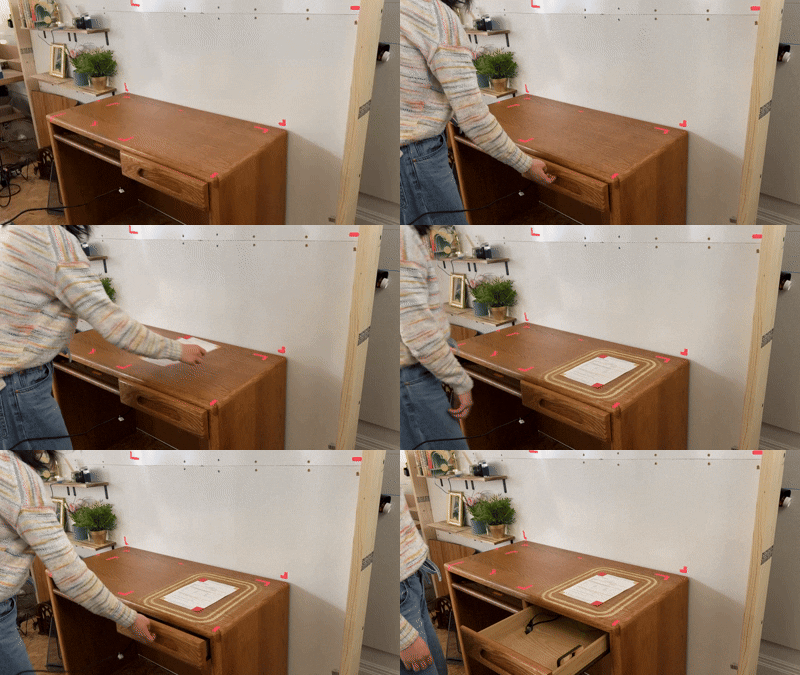
You play a psychiatrist investigating the sudden disappearance of your patient, a brilliant yet troubled mind obsessed with patterns and codes. As you step into his chaotic home, scattered clues and eerie projections hint at a deeper mystery. To uncover what really happened—and your role in it—you must piece together the fragments he's left behind.


My Role
Blending Narrative and Tech
As the creative technologist on this project, I was responsible for designing and implementing both the interactive software and physical hardware systems. I used TouchDesigner and physical computing techniques to bring the narrative to life through responsive interactions, sensory triggers, and projection mapping. From building the physical structure to integrating sensors and coded logic, I ensured a seamless blend of storytelling and technology. This was a two-person collaboration, with Carissa and I working closely together, each contributing equally to concept development, design decisions, and execution.
I want to extend my thanks to Carissa for crafting a cohesive visual language that transformed our constrained space into an immersive environment. Her thoughtful design choices amplified the room’s ambiance and elevated the overall storytelling experience.


Research & Insights
Designing for Immersion and Discovery
Design Process
Translating Story into Space and Interaction
Reflection
The Hardest Tasks Often Look the Simplest
To ground our experience in real-world logic and emotional authenticity, we studied classic escape room mechanics, narrative games, and immersive theater techniques. We analyzed how users interact with physical spaces under time pressure, and how subtle cues can guide behavior without breaking immersion. Our research included visiting escape rooms, studying user flow patterns, and referencing psychological case studies to better shape the psychiatrist–patient dynamic. These insights helped us create an experience that feels intuitive yet layered—inviting curiosity, rewarding attention to detail, and supporting a slow-burn narrative reveal.
Our process began with narrative ideation—mapping out the storyline, character backstory, and key emotional beats. This narrative foundation guided our spatial planning and interaction design. We sketched layouts, mapped puzzle flow, and identified key narrative moments to anchor within the space. Using cardboard mockups and quick physical builds, we prototyped interactions while simultaneously developing reactive visuals and logic systems in TouchDesigner. Playtesting was essential as early tests surfaced clarity issues and moments of confusion, which we addressed by refining prop placement, pacing, and adding subtle environmental cues. These insights helped us create an experience that feels intuitive yet layered, inviting curiosity, rewarding attention to detail, and supporting a slow-burn narrative reveal.
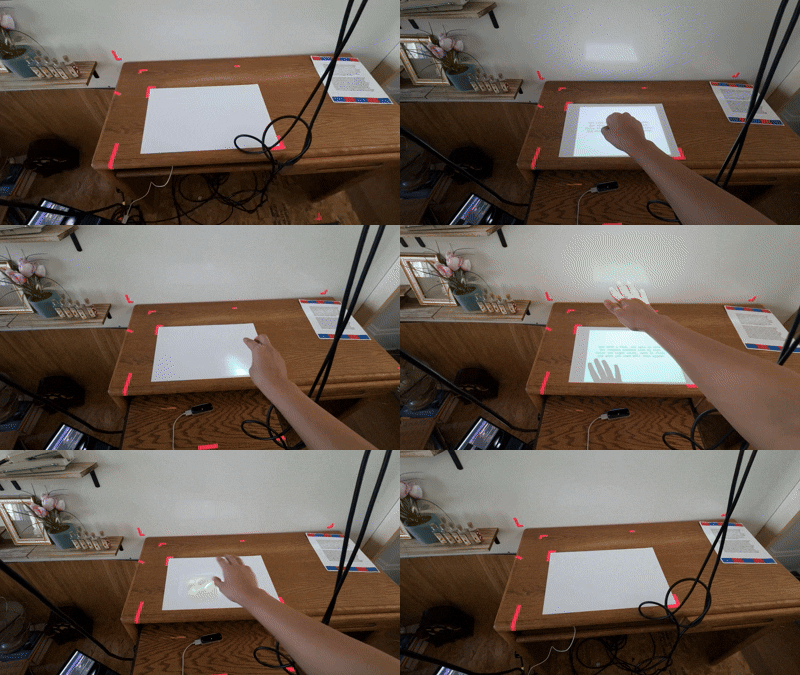
This project pushed us in unexpected ways—from building complex interactions to mounting a projector six feet overhead with limited resources and no prior experience. What seemed like a simple technical hurdle ended up being one of the riskiest leaps of faith.
We learned that the smallest details matter—players inspected every prop, from labeled pill bottles to old vinyl records, with incredible curiosity. That level of immersion showed us the value of designing even the “background” with intention.
Evaluating puzzles through a user experience lens challenged us to embrace ambiguity. Not everyone needed to “get it” instantly; instead, we focused on creating subtle feedback loops to help players feel confident when they were on the right path—or not.
Most importantly, this project was built on the backs of our community. Friends, professors, acquaintances—everyone played a part, whether by lending materials, offering feedback, or simply listening. While the original vision relied on CMU’s physical resources, we came to realize it was really the people around us who made this project possible.
.jpg)